

Home / Exhibition
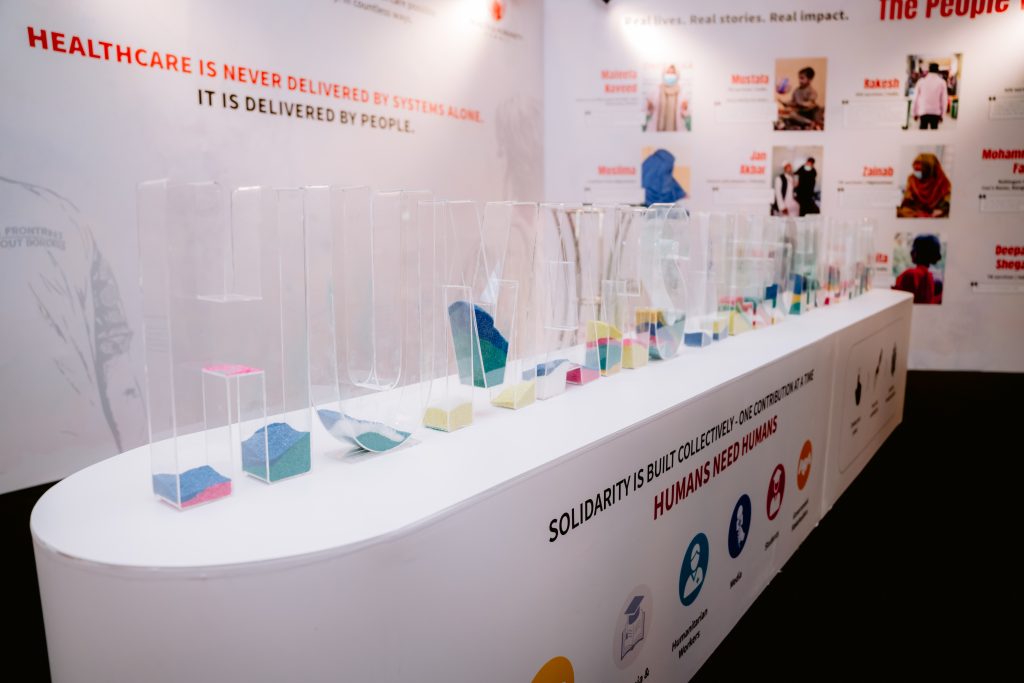
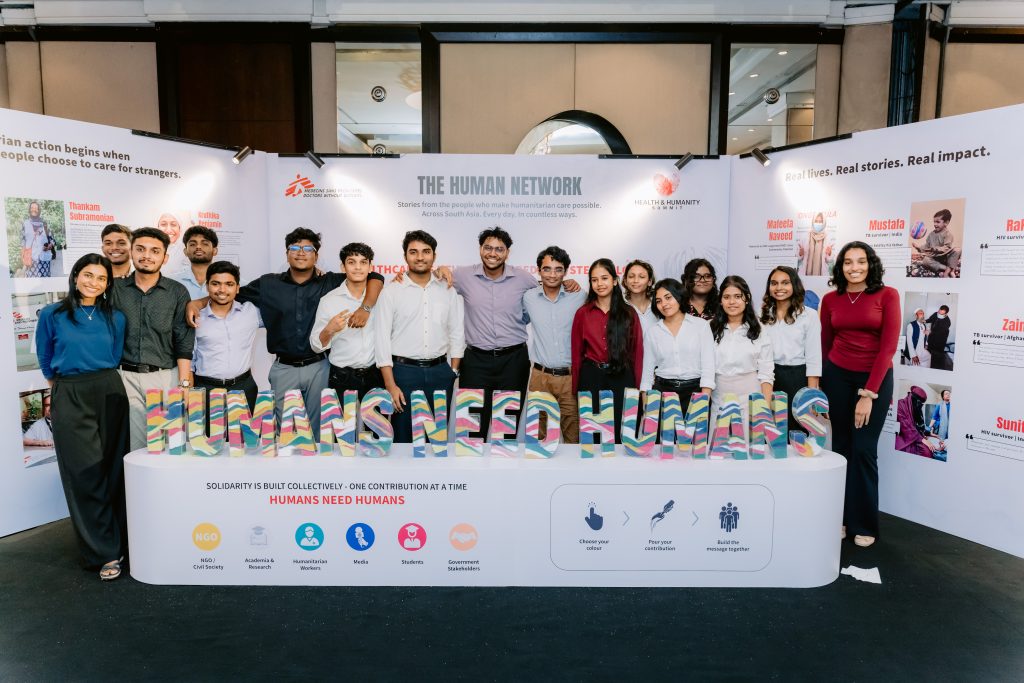
At the summit, solidarity was not just discussed, it was made visible.
The Humans Need Humans art installation invited event participants to take part in a collective act of creation. Each participant selects a colour and pours it into the sculpture, adding their contribution to a shared artwork that evolved over the course of the event.
With every layer added, the installation became a living reflection of humanitarian action itself: shaped by many hands, many perspectives, and a common purpose.
More than an artistic experience, Humans Need Humans is a reminder that no single person, organisation, or sector can meet today’s humanitarian challenges alone. Meaningful action depends on collaboration — built step by step, contribution by contribution.
By the end of the summit, the completed sculpture stood as a powerful visual symbol of collective responsibility and shared humanity.
The installation carries a simple but powerful message: solidarity is built collectively — one contribution at a time. That’s how YOUR Humanity Heals.
In a space where ideas, commitments, and partnerships come together, Humans Need Humans offers participants a chance to leave not only with words and intentions, but with a visible reminder that progress is made together.
Spotlight speakers from South Asia — Dr Roshni Changalath, Imtiaz Wadud, and Dr Karan Kamble — brought to life the realities faced by aid workers and patients in some of the world’s most challenging contexts.
Having served across multiple MSF country programmes, the three speakers drew on their own frontline experiences to share powerful accounts of conflict, crisis, and care under extreme pressure. Through stories rooted in lived experience, MSF’s international mobile staff (IMS) spoke candidly about the difficult truths of humanitarian work, while also highlighting the resilience of patients, communities, and frontline responders.
Their reflections grounded the event in the human realities behind emergency response, reminding participants that behind every crisis are people navigating devastation, loss, courage, and hope.
In her address, Dr Roshni Changalath reflected on how humanitarian healthcare is shaped not only by hospitals and medicines, but by the many social, political, and economic barriers that determine who can access care in the first place. Drawing on her MSF experience in Afghanistan and Malawi, she highlighted how healthcare often begins long before a patient reaches a clinic.
Through stories of women in Afghanistan whose medical training was interrupted or cut short, she showed how excluding women from education and leadership directly weakens health systems and restricts access to care — especially in contexts where female healthcare workers are essential for women patients. Her remarks underscored that healthcare access is not only a workforce issue, but also a matter of rights, representation, and power.
Reflecting on MSF’s mobile cervical cancer screening work in Malawi, Dr Changalath described how even when services are available, women may still face major obstacles to seeking care, including lost wages, childcare responsibilities, lack of information, and mistrust. These experiences, she said, reshaped her understanding of access: it is not just about distance to a hospital, but whether people can afford to come, feel safe, and be treated with dignity.
At the heart of her message was a call to look beyond systems and statistics to the people living within them. Humanitarian healthcare, she reminded the audience, depends on listening, bearing witness, and asking who is missing from the rooms where decisions are made.
In a deeply personal and thought-provoking address, Dr Karan Kamble reflected on what humanitarianism means beyond organisations, protocols, and medical systems. Drawing on more than a decade of experience with MSF across India, South Sudan, Greece, Kenya, Cambodia, and the Philippines, he shared how humanitarian action begins with a simple but powerful decision: recognising that another person’s suffering matters.
Through frontline stories of caring for a woman with terminal cancer in Manipur, improvising lifesaving treatment for a young man with tetanus in South Sudan, and witnessing the protective power of humanitarian presence for migrants arriving in Greece, Dr Kamble highlighted that humanitarian medicine is not only about curing, but also about relieving suffering, standing by people, and refusing to look away.
He also spoke about the growing complexity of humanitarian work — from negotiating access in difficult social and political contexts to responding to climate-sensitive diseases in fragile health systems. His remarks underscored that meaningful humanitarian action is always collective, shaped by patients, families, colleagues, and communities alike.
At the heart of his message was a reminder that when systems fail and resources run short, humanity itself remains essential: presence, courage, compassion, and the willingness to show up for one another.
Drawing on his journey from Bangladesh to MSF projects in South Sudan, Ethiopia, and Rohingya refugee camps in Cox’s Bazar, Imtiaz Wadud shared stories that illustrated both the operational realities of aid work and the human meaning behind it.
He recalled managing critical flight operations supporting MSF projects in South Sudan, where medical referrals often depended on fragile aviation links in extremely high-risk settings. The story highlighted how humanitarian action is often built through adaptation, learning, and improving systems in difficult environments.
Imtiaz also spoke about the moment his understanding of humanitarian work changed: visiting a remote community in Bangladesh where MSF’s mobile clinic was the only accessible healthcare for people living far from any health facility. That experience, he said, revealed the profound gap between people’s needs and the services available to them — and deepened his commitment to humanitarian work.
Reflecting on later assignments, including work with Eritrean refugees in Ethiopia and Rohingya refugees in Bangladesh, he emphasized the human cost of displacement, especially for children and families forced to flee with no certainty of safety or return. He also warned of the growing impact of funding cuts across humanitarian settings, as essential services are reduced while needs remain acute.
At the heart of his message was a call to look beyond statistics and recognise shared humanity. Humanitarianism, he reminded the audience, is not charity but solidarity — rooted in dignity, presence, and the understanding that humans need humans.
Nitesh shares his journey as a two-time DRTB survivor — from stigma, isolation, and a life-threatening hospital stay to becoming an advocate for others affected by TB. Today, Nitesh is helping build awareness and peer support through the TB Survivors Collective, proving that life after TB is possible — and that no one should have to face it alone.
“I am a two-time DRTB survivor, and now I want to help others.”
Shawkat Ara shared a deeply personal account of displacement, interrupted education, and rebuilding her future as a Rohingya refugee and humanitarian worker. Originally from Buthidaung Township in Myanmar, she described how her life changed in 2017, when she fled with her family to Bangladesh and lost not only her home, but also her access to education.
Living in the refugee camps, Shaukat Ara faced the difficult reality of choosing work over school in order to support her family. Through her work with MSF in different community-based roles, including health promotion and support for survivors of sexual and gender-based violence, she became closely involved in supporting women, girls, and families in her community. These experiences, she said, helped her understand that humanitarian work is not only about providing services, but also about listening, respecting dignity, and ensuring affected communities have a voice.
She also reflected on her determination to return to learning despite years of disruption. Through the Refugee Higher Education Access Programme, she resumed her studies, graduated, and later secured a scholarship to pursue a bachelor’s degree in the Philippines. For her, education represents not only personal achievement, but also the opportunity to better serve her community and help create pathways for other Rohingya women and young people.
At the heart of her message was a powerful appeal not to forget the Rohingya crisis. She called for solidarity, dignity, and the right of Rohingya refugees to return home safely, while urging the audience to continue standing with communities whose futures remain uncertain.
The Health & Humanity Summit 2026 Exhibition invites you to witness, reflect, and engage with the critical challenges and opportunities facing humanitarian healthcare today.
The humanitarian financing model is at an inflection point. Shifting aid budgets, debt pressures, and
geopolitical competition are prompting a long-overdue conversation about how the system is funded and
governed. Encouragingly, many Global South countries now finance more of their own healthcare than ever
before — a sign of growing capacity and ownership. The task ahead is to ensure decision-making power
evolves in step, so that priorities are shaped by equitable need and shared responsibility rather than political
visibility alone. The panel explores the growing role that wealthier Global South economies — Gulf states,
India, China, Singapore — can play in humanitarian governance, and what would make fuller participation
attractive and meaningful. The opportunity at stake is significant: a broader, more representative table for
setting priorities, and a future architecture of sovereignty, financing, and governance built by and for a wider
community of actors.
Health and humanitarian systems are powered by women’s labor — as doctors, nurses, community health
workers, and caregivers. This is one of the sector’s greatest strengths, and its fullest potential is yet to be
realized: women remain underrepresented in leadership and decision-making, and their work is too often
framed as service or sacrifice rather than the skilled, political labor it is. India’s ASHA workers, for instance,
proved indispensable during COVID-19 — a powerful demonstration of what community health leadership can
achieve, and a compelling case for the recognition and investment that should follow. Expanding access to
education and public participation, including in contexts such as Afghanistan, is central to strengthening the
long-term resilience of the systems women sustain. The panel examines the political economy of care work
and asks how humanitarian and health systems can harness this expertise fully: who defines priorities, whose
knowledge counts, and what more equitable models of leadership and labor look like in practice.
COVID-19 made clear that access to medicines, diagnostics, and vaccines is a political choice as much as a
scientific one — and, equally, that political choices can widen access dramatically when solidarity leads. This
recognition has moved health sovereignty to the center of global health debates, understood not as isolation
or self-sufficiency but as the capacity to cooperate, share knowledge, and build regional manufacturing while
staying connected to global research and solidarity. Traditional South–South solidarity, rooted in shared
history, is being renewed and reimagined for a new era of economic dynamism and evolving alliances. This
panel will examine intellectual property, technology transfer, and regional manufacturing, and chart the forms
of international cooperation best placed to support resilient, equitable health systems that are both selfreliant
and outward-looking.